
Parts And Spares For Orbea Katu-E Bikes - epartsfinder
Innovation lies at the heart of OEMs. They consistently push their boundaries with investments in research and technology to improve their current components and create new solutions. These innovations can often reshape the trajectory of an entire industry. Many of the solutions we currently use result from an OEMâs pursuitsâGPS navigation, anti-lock braking systems (ABS), and autonomous vehicles are great examples.
Establish clear communication channels and protocols when working with an OEM. Doing this helps to ensure clarity when sharing technical details like specifications, requirements, or standards, especially when starting your contract with the OEM.
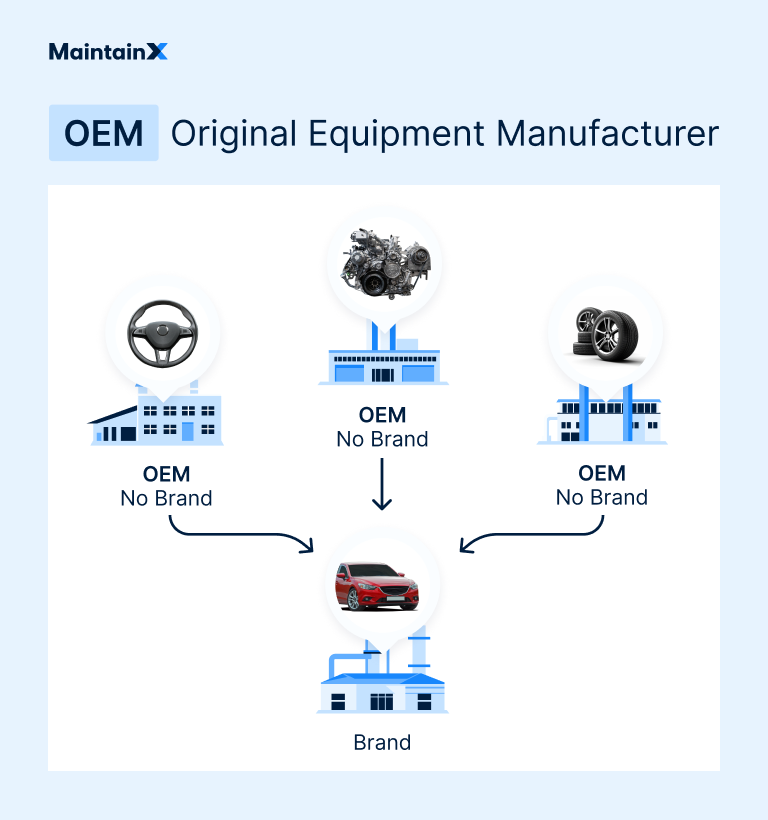
Manufacturers like BMW, for example, design, create, and sell their products made up of countless sub-assembly parts. These parts come from OEMs like Bosch, while BMW functions as a VAR, assembling the parts to its own specifications and offering added value in the form of unique designs, extra features, the BMW brand name, support services, and much more.
Not all OEMs function equally. Despite the cost and operational benefits of partnering with an OEM, working with the wrong one can mean you risk products poorly suited to your needs. Devote time to assessing the technical expertise of potential OEM partnersâinspect their products and facilities, seek customer feedback, and work with your engineering team to ensure the OEMâs outputs meet your technical standards.
Balancing complex equipment maintenance, peak performance, and resource efficiency can be challenging. Between trying to meet customer demand, managing labor optimally, and keeping equipment in good working order, it can be easy to lose sight of seemingly minor issues like finding the right equipment parts.
A company can purchase a Caterpillar skid steer loader in its entirety from Caterpillar, the original equipment manufacturer. And when it's time to replace the air filter, the company can source the genuine part directly from the OEM or purchase a different brand of filters from other companies.
Note that some manufacturers also sell components that compete with OEM parts. These components are called aftermarket replacement parts. Customers will typically use an aftermarket part when the original product or part fails and needs replacing. This is exactly why your mechanic doesnât ask you to get a replacement from the OEM when you repair your car.
oem代工
Semua sampel sudah dalam keadaan dicetak, bukan sesuai data pemesan.Berisi 6 sampel undangan Rustic Varian Komplit dengan tipe:
Foxconn Technology Group is a popular OEM in the hardware space. The company produces a range of electronic components, including printed circuit boards (PCBs), displays, and connectors. Foxconn sells these components to companies like Apple, Dell, and Sony.
Many kinds of parts exist in the market, and maintenance managers who do not pay close enough attention to their choices must be ready to face incompatibility issues, increased downtime, and compromised safety. Working with the right original equipment manufacturers (OEMs) to source the parts that you need is critical to reducing maintenance costs, improving asset performance, and reducing unplanned downtime.
An original equipment manufacturer (OEM) specializes in producing components or equipment used in another company's end product. For example, automotive companies like BMW, Ford, and Mercedes-Benz buy components from OEMs like Bosch and Continental and integrate the components into the final cars under their brand name. Instead of selling directly to consumers, OEMs work closely with these companies, known as a value-added resellers (VAR), to create customized components or equipment based on their needs and specifications.
OEMs offer companies specialized components at lower costs and with higher reliability. Because they specialize in producing specific components, they develop expertise and technological capabilities in manufacturing that product.
Original equipment manufacturers play a crucial role in the maintenance of equipment and machinery. OEMs produce the components or equipment used in another company's end product, making them essential partners for maintenance managers. In this post, we'll explain what OEMs are, how they work, and the benefits they provide to manufacturers.
However, one significant risk of ODM is that sellers can struggle to stand out from competitors as, despite the small changes and customizations, the products are still the same.
oem和odm的区别
Some of the largest companies in the world rely on OEMs to source components for their productsâand remember, these are companies with big pockets. Wonder why? Here are a few reasons:
Partnering with future-ready OEMs is vital to your success. Look for OEMs prepared to invest in or have already invested in innovative technologies. Theyâll help you build better products faster through their innovative offering.
oem意思
Sure, OEM partnerships can contribute to your success. But there are various things to consider before selecting an OEM: product quality, reliability, technical capabilities, and facility standards are a few examples. Reliability is essential because a lack of parts can translate to downtime.
The aftermarket is the market for third-party manufacturer parts that perform the same function as OEM parts. Aftermarket parts are often compatible with products from a wide range of manufacturers, unlike OEM parts, which are typically optimized to work with specific products from specific manufacturers.
OEMs in the automotive industry produce components and systems used in manufacturing vehicles. Automotive OEMs fall into categoriesâTier 1, 2, and 3. Tier 1 OEMs produce entire systems or major components like engines, braking systems, and steering assemblies. Tier 2 and 3 OEMs produce smaller components and subsystems like seats and specialized materials.
Another example is the relationship between the Ford Motor Company and Motorcraft. Motorcraft is an OEM that supplies parts to Fordâin fact, Ford owns Motorcraft. Despite this relationship, Motorcraft functions autonomously and supplies parts to other car manufacturers such as Mazda. In addition, not all Ford parts come from Motorcraft, and the company sources components from other OEMs. Like BMW, Ford acts as a VAR here, assembling a car out of parts from its affiliated OEM (Motorcraft) and other OEMs like Bosch.
In the case of original design manufacturing (ODM), one company or customer selects an existing product design from a manufacturer, makes slight changes or customizations, and sells it under their brand name.
ODM reduces the amount of work the seller has to perform in manufacturing. Instead of investing time and resources in product development, they can focus their attention and energies on branding and marketing strategies.
PCs enter the market under a brand name, such as Lenovo or Dell. However, the computer manufacturer uses many other OEM products to build the computer. For example, a Lenovo PC may include an operating system from Microsoft, a processor from Intel, and computer software from Adobe.
oem中文

Itâs also important to factor in the local regulatorâs interpretation of the IP laws. For example, most Chinese courts agreed that OEM-related products bearing identical or similar trademarks constituted infringements. But between 2010 and 2015, the SPC made various retrial judgments that held that simply affixing trademarks to OEM-related products doesnât translate to infringement. Things changed again with the Honda case in 2019.
oem品牌
Consider signing non-disclosure agreements (NDAs) to prevent the OEM from disclosing proprietary data to third parties. License terms are also criticalâsign an agreement to establish the scope, duration, restrictions, and royalty payments for the licensed IP.
Companies also work with OEMs because they can achieve greater cost efficiency. Because they work with multiple companies, they can produce specialized parts at scale. And economies of scale allow OEMs to produce parts at a cost much lower than if done in-house.
OEMs produce specialized components that manufacturers use to produce a finished product. Manufacturers are buyers of these OEM components. They use OEM components to create finished products. For example, Bosch (an OEM) supplies fuel injection systems to BMW (a manufacturer).
Caroline Eisner is a writer and editor with experience across the profit and nonprofit sectors, government, education, and financial organizations. She has held leadership positions in K16 institutions and has led large-scale digital projects, interactive websites, and a business writing consultancy.
oem厂家
The auto industry is perhaps the simplest example of an end product built from a network of original equipment manufacturer relationships. Your average Ford pickup may have hundreds of OEM auto parts that come together to form the final product. Everything from the GPS to the air conditioning compressor likely comes from individual original equipment manufacturers.
You might have varying component needsâfactors like seasonality and macroeconomic factors can drive your demand. Working with OEMs allows you to scale back or scale up orders as needed. OEMs can typically support this since they serve a diversified clientele.
âAfter the 'Honda' case in 2019, Chinese courts adopted the judgment that affixing trade marks on OEM-related products constitutes trademark use, and thus expressed cautious optimism about the defense of noninfringement by OEM activities.â
oem汽车
For growing manufacturers, partnering with OEMsâparticularly those with the capacity to meet your needsâcan significantly speed up operations by saving you time, effort, and resources that would otherwise go into manufacturing parts from scratch. However, partnering with an OEM lacking the capacity to upscale can hinder your attempts to grow, leaving you stuck and potentially needing a new partner at crucial times. Pay attention to their capacity and ability to upscale production to meet your future needs when evaluating OEM.
OEMs manufacture components for other businesses. The purchasing company integrates the components into their finished product. These components often adhere to the purchasing companyâs specifications and designs.
An OEM partnership and CMMS are vital to a successful maintenance strategy. OEMs offer expertise, technical knowledge, and access to high-quality parts, and CMMS software helps manage maintenance tasks and parts inventory, collaborate with technicians, and analyze maintenance data. Hereâs why you also need a CMMS:
Aftermarket products can be cost-effective in the short term, but itâs wise not to be tempted by their cheapness. One reason for this is that they arenât always of the same quality as OEM parts, and while they may work as well at first, their reduced durability and quality lifespan may diminish their lifespans.
Value-added resellers (VARs) manufacture finished products from parts produced by OEMs. As the name suggests, VARs offer additional benefits to consumers, such as extra features integrated into the product, after-sales services and support, or value in the form of a trusted brand name. In practice, an OEM can make several parts that different VARs purchase and assemble into other products under their brand names. The OEM will often create according to the VARâs requirements.
Rapid advancements in technology has revolutionized production processes and redefined the very essence of modern manufacturing. OEMs stand poised on the cusp of a new era as innovation drive improvements in efficiency, productivity, and sustainability. Here are some ways OEMs are taking advantage of technology to transform their business:
In addition, performance issues may arise as aftermarket parts exist to serve a wide range of equipment, meaning they often lack the level of customization OEM parts have for your particular machines. You can be sure OEM parts will fit and work right.
oem/ odm
ODM also benefits the manufacturer, as producing the same design in large quantities reduces the unit cost of each product.
VARs also sell OEM products directly to consumers. For example, BMW (a VAR) procures fuel injection systems from Bosch (an OEM) and uses them in its car assembly. However, a customer who needs a replacement fuel injection system neednât go to Bosch and can purchase one directly from BMW or the aftermarket (more on this shortly).
In addition to the aftermarket and ODMs, you can also source components from resellers and distributors. Hereâs a quick overview of how theyâre different that shows OEMs are your best bet:
Work out who will retain ownership before collaborating with an OEM on developing a new IP. Being upfront about this helps to prevent future legal conflicts and ensure a smooth and beneficial collaboration.
Original Equipment Manufacturers (OEMs) play a crucial role in industrial maintenance, contributing to the efficiency, reliability, and longevity of equipment and machinery.
One of the most common applications of original equipment manufacturing is in the automotive industry. The average car comprises thousands of partsâbrake pads, exhaust systems, windshield glass, window switches, chair springs, nuts, bolts, etc. However, producing all of these components on a car-by-car basis would be an arduous endeavor for even the most accomplished vehicle manufacturing division.
In addition to a reliable OEM partner, you also need dependable assets. Keeping up with maintenance schedules is critical to ensuring asset reliability. MaintainX helps streamline and automate critical parts of your maintenance schedule. If youâre interested in learning how MaintainX can transform your maintenance process, book a demo today.
For example, suppose an original design manufacturer has a catalog with phone charger designs. Two companies can choose to have the ODM produce the charger in different colors. The products retain the same general design, but branding, packaging, and other aesthetic factors follow each buyerâs specifications.



 Neil
Neil 
 Neil
Neil