
Documents for reference 001036: Public Access - 001036
On a day that peaks around 95°F, two A/Cs running continuously can keep 850 sqft in the mid-70s. My IR thermometer says the ceiling is considerably warmer than the walls, so it would probably be useful to improve the attic insulation.
In addition to providing accurate readings, calibration of the FLUKE ESA609 also helps ensure that the device is functioning properly. Calibration helps to identify any potential issues with the analyzer, such as worn parts or other problems. By identifying and repairing any issues, the analyzer can continue to provide accurate readings and help to ensure the safety of electrical equipment.
For the improved version, I used mass loaded vinyl (MLV) wrapped in cotton blanket with velcro strips, held together using staples.
When I connect a 10K resistor between (e.g.) Y1<->C on My Nest 3rd Generation, it has no trouble detecting that a device is present, but I've heard reports that the Nest E needs a heavier load. Adding a 1K resistor (rated for at least 1 watt) in parallel with the Y1<->C connection should be sufficient.
It's possible to synchronize the fan speed by briefly running DEHUMIDIFY (which forces the fan to LOW), but I decided not to do this, and just let the user choose the fan speed.
TOTAL Calibration Solutions is a customer-based business, and as such strives to make sure that the customer is delivered an excellent experience. Transparency, speed, and quality of service are tenets that TOTAL Calibration Solutions uphold consistently. As such, TOTAL Calibration Solutions provides a customer portal that allows instant access to all previous calibration certificates, as well as other free services that can help manage any instruments in your system. Recall reports, delinquent reports, and other services are all free for customers, which can reduce the stress of calibration and asset management. TOTAL Calibration Solutions is perfectly suited to handle any needs or requests that you may have.
Thank you. I had suspected that the gap was to prevent the unit from filling with water, though it seems bigger than necessary.
FlukeVT650
This was repeated 3 times in the factory configuration (red lines), 3 times with the gaps sealed (blue lines), and finally 2 times in "single hose mode" (black lines) with the intake sucking directly from the closet space. I logged the temperature using a phone pointed at a thermometer, running Open Camera on 10-second repeat:
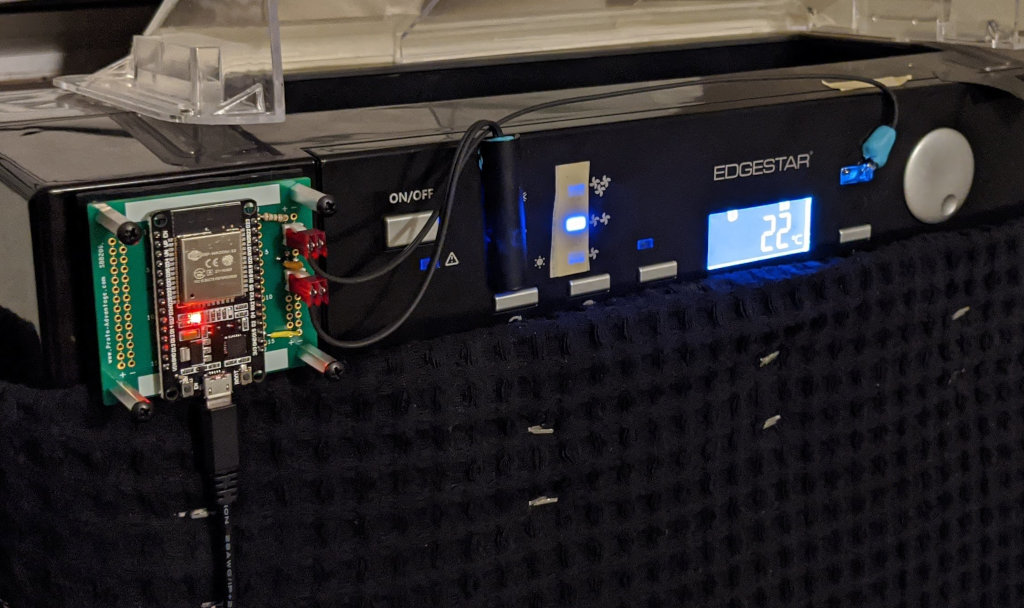
Here is the thermostat enclosure with everything mounted, including a 24VAC to 5VDC power supply at the bottom. I stuck with MicroUSB, so I can't forget to unplug the power before reprogramming it.
Reverse engineered IR protocol: all marks are the same length, with data encoded in the spaces. There appear to be 32 bits per packet, organized as [id, ~id, code, ~code]. I tried sending all 256 codes, hoping to find undocumented features like "set power to X" or "set mode to X", but alas, they were all just duplicates of the standard 6 buttons, so understanding the protocol is pretty useless.
The hoses may be insulated using a 6 inch "tubular cotton stockinette bandage". After 5 minutes of runtime with 2 layers of cotton, I measured 122°F at the hose and 102°F at the cotton surface. This isn't the greatest insulating material, but it's cheap, easy, and looks reasonable enough.
To attach the 24VAC wires, I took some 3.5mm screw terminal blocks (TE 1776275-6), bent the pins sideways, and soldered them to form a bus. The exposed metal was wrapped with electrical tape.
I cut a ballpoint pen in half, painted it black, and placed it over the mode status LEDs, with an INL-3APD80 photodiode to detect brightness changes when cycling through modes. The photodiode seems to work best in photovoltaic mode, with anode connected to an ADC input, and cathode connected to GND. I do a read every 50 microseconds, and average across 1000ms (20000 samples) to get a clean signal. Adding a capacitor in parallel with the photodiode reduces the stabilization time; 10nF seems like a good balance between noise and responsiveness, reducing the read time to 100-200ms.
I recently purchased a couple EdgeStar AP14001HS dual-hose air conditioners, and noticed that the intake hose moves quite a bit less air than the exhaust hose. It seems that the extra air is "leaking" into the condenser compartment where the bottom meets the front of the unit. See the attached photo, where I temporarily covered the gap with masking tape. Are you able to tell me whether this gap serves a necessary function? Otherwise, I would rather leave it covered, because I chose a dual-hose model to keep the inside/outside air isolated from each other.
With the unit running for hours when it's 90°F outside, the hottest point under the blanket is around 94°F, so it seems to do a reasonable job of keeping itself cool.
I plan to run these in "heat" mode during the winter, which should consume less energy than the resistive baseboard heaters, but time will tell how well that works.
TOTAL Calibration Solutions offers FLUKE ESA609 calibration services. We understand the importance of your FLUKE ESA609 ELECTRICAL SAFETY ANALYZER so you can count on us to get it back to you as fast as possible to prevent any downtime you may experience during the calibration process. TOTAL Calibration Solutions is an ISO/IEC 17025 and ANSI/NCSL Z540-1-1994 accredited Ohio-based calibration company. This accreditation is just one of many ways that shows the fast and capable calibration and repair services that TOTAL Calibration Solutions provides. Our team of highly trained and diverse technicians backed up with some of the most modern calibration instruments available can quickly and efficiently calibrate your FLUKE ESA609 and any other instruments that that you may have.
(In this photo, note that I taped over the LEDs to reduce brightness, and the chunk of foam was from an abandoned soundproofing experiment involving repositionable adhesive.)
I find it disgraceful that the portable A/C companies are so clueless about efficiency that improvements can be made using basic household supplies. This reminds me of the computer PSU industry before 80 Plus, where everything is garbage and nobody knows what to buy. Why is all the innovation focused on single-hose designs?
I couldn't find an enclosure with the right dimensions, so I cut out some ABS rectangles with a utility knife, attached using 5mm and 12mm M3 screws, with 18mm standoffs and 5mm spacers.
Finally, if you decide to open the unit (a 12-inch #2 Philips screwdriver is helpful), it's possible to tape over some internal hose/wiring gaps, but I'm not sure how important these are.
After sealing these gaps, I could feel more air moving through the intake port, and less air coming from the exhaust when I briefly obstruct the intake.
Bud Industries CU-387 enclosure with Vigortronix VTX-146-030-212. The transformer converts 120VAC (parallel windings) to roughly 30VAC, or 208VAC (series windings) to roughly 25VAC. I roughened the plastic with sandpaper and epoxied 6mm M3 standoffs in place; hopefully that'll hold well enough.
It's possible that http://www.climax-air.com/ knows what they're doing, since they make (as far as I know in 2020) the only dual-hose portable with a variable-speed compressor. But I've only looked at the website, since their supply is very limited. Maybe I'll check again when the EdgeStars wear out.
I captured the remote codes using LIRC's mode2, which provides mark/space times in microseconds, compatible with the sendRaw() function mentioned previously.
Pico was made by Gilbert Pellegrom and is maintained by The Pico Community. Released under the MIT license.
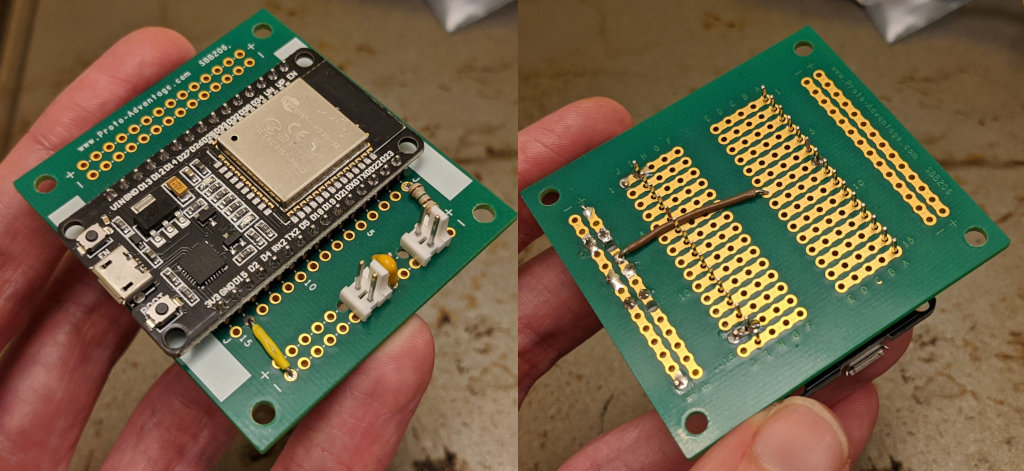
The circuit board is a Proto Advantage SBB206. It fits the 15-row ESP32 dev board exactly, though it'd be nice if the dev board were 1 pin narrower. Drilling holes in the power rails lets them hold general-purpose components.
FlukeESA620
Each 24VAC relay output drives the input pins of an SFH620AGB optocoupler through a 10K resistor (24V / 10kohm will push a few mA through the optocoupler LEDs). The optocoupler is compatible with GPIO in INPUT_PULLUP mode, using a bit of software to clean up the signal. I got the idea from this StackExchange post, though 24VAC is less scary than 120-240VAC.
Without proper calibration, the FLUKE ESA609 may provide inaccurate readings, which can lead to faulty electrical equipment. This can lead to safety hazards, such as electric shock, fires, or other dangerous situations. Calibration also helps ensure that the analyzer is providing readings that are consistent with industry standards.
This unit blows indoor air mostly upwards. I opened the case to remove the built-in deflector, and put a Frost King HD9 in its place. This creates a roughly-horizontal air stream, and also seems slightly quieter without those extra fins in the way.
I cut the MLV to size using a tape measure, square, pencil, and scissors. Removing the bottom corners leaves room for the power cord. The wings have different lengths because the power cord is off-center.
The FLUKE ESA609 Electrical Safety Analyzer is an essential tool for any electrical technician. It is used to test and verify the safety of electrical equipment, such as circuit breakers, GFCIs, and other safety devices. A properly calibrated FLUKE ESA609 can help ensure that electrical equipment is safe and functioning properly.
However, when I feel the intake and exhaust hoses on the AP14001HS, the volume of air moving through the intake is considerably smaller, so air must be leaking from the room into the condenser compartment, and also between the room and outside while the blower is off. There are two major locations where this happens:
It doesn't look like there has been factory level testing with the gap sealed, but the engineers who work on these units have performed their own tests and found covering this gap to not be an issue. They weren't able to give me additional information on the SACC though as it's not something we can test at this location.
It's possible to set a specific temperature by sending enough DOWN commands to reach the minimum value, followed by enough UP commands to reach the desired temperature. In theory, the controller could always use 16C for cooling and 32C for idle, but I prefer 18C-27C, because it only needs 9 clicks (shorter beep), and the user can manually raise the cooling point to prevent a smaller room from getting unreasonably cold. Manual adjustment is only possible in celsius mode due to the temperature corruption bug, so it's unfortunate that unplugging the power reverts to fahrenheit. My best idea was to initialize cooling mode by sending enough UP commands to max out the fahrenheit range, and likewise for DOWN commands in heating mode. All adjustments after this point assume celsius, so the temperature will never get cold enough to cool, or hot enough to heat, until the user restores celsius mode and reboots the ESP32. In other words, it seems better to never work than sort of work.
FlukeElectrical Safety Analyzer Price
I don't think my setup is rigorous enough to calculate any absolute efficiency numbers, but clearly the sealed configuration does a better job of cooling, and single-hose mode is abysmal.
The junction box originally held a 208VAC thermostat for baseboard heat. I added a Schneider Electric 92S7A22D-24 relay, which the Nest identifies as "aux heat" via the white wire. Actually, the relay and transformer are the only components needed to use the Nest as a line-voltage thermostat.
I wanted a dual-hose air conditioner because single-hose models are thermodynamically suboptimal. Blowing hot air out the window creates negative pressure in the room, which sucks outdoor air back inside through various cracks. In theory, dual-hose models avoid this problem by cooling the condenser with outdoor air, which is then re-exhausted.
FlukeESA612
I connected an ESP32 microcontroller to the "compressor relay stage 1" (Y1) and "heat pump changeover valve" (O) outputs of a Nest thermostat, with "auxiliary heat" driving a relay for my baseboard heaters. (I've tested that the Nest can individually turn everything on, but time will tell how it juggles two kinds of heat in the winter.)
Places like the Bay Area are full of apartments and condos that are gradually becoming unlivable as temperatures rise, so it would be nice if people could just throw money at a decent product.
On the air conditioner side, I'm driving a generic IR LED through a 150 ohm resistor, using the sendRaw() function from IRremoteESP8266.
Pushing and bending hundreds of staples was quite a lot of work. I think I would recommend that a sane person stop with the initial "folded blanket and tape" solution, since it just takes a few minutes, and MLV isn't tremendously better.
Our versatile, ISO/IEC 17025:2017 and ANSI/NCSL Z540-1-1994 accredited calibration laboratory offers on-site, in-house calibration, and repair services
I bought a couple EdgeStar AP14001HS portable air conditioners in April 2020, since I expect to spend most of the Summer at home. I'm not able to use window A/Cs here, though that would be the obvious choice for efficiency because all the hot parts remain outside.
Each unit consumes about 10.5 amps, so it's important to map out which circuit breakers feed which outlets, and avoid sharing a circuit with a high-drain appliance like a microwave or electric kettle. Ideally, they should also sit on opposite legs of the main breaker. So far, I've had no issues sharing a 15 amp circuit with a refrigerator or computer.
Fluke esa609price
The plastic gets pulled toward the rear while the compressor is running, and toward the front otherwise, so a piece of tape can help hold it in place.
The photodiode and IR LED dongles are attached to 22AWG MTA-100 connectors. I used a small screwdriver in lieu of the $35 Insertion Tool.
Calibration of the FLUKE ESA609 is an important process that helps ensure that the analyzer is providing accurate readings. Calibration involves comparing the analyzer’s readings to known values, and then making adjustments to the device to ensure that it is providing accurate readings. The process is designed to ensure that the measurements taken by the analyzer are accurate and reliable.
Fluke esa609manual
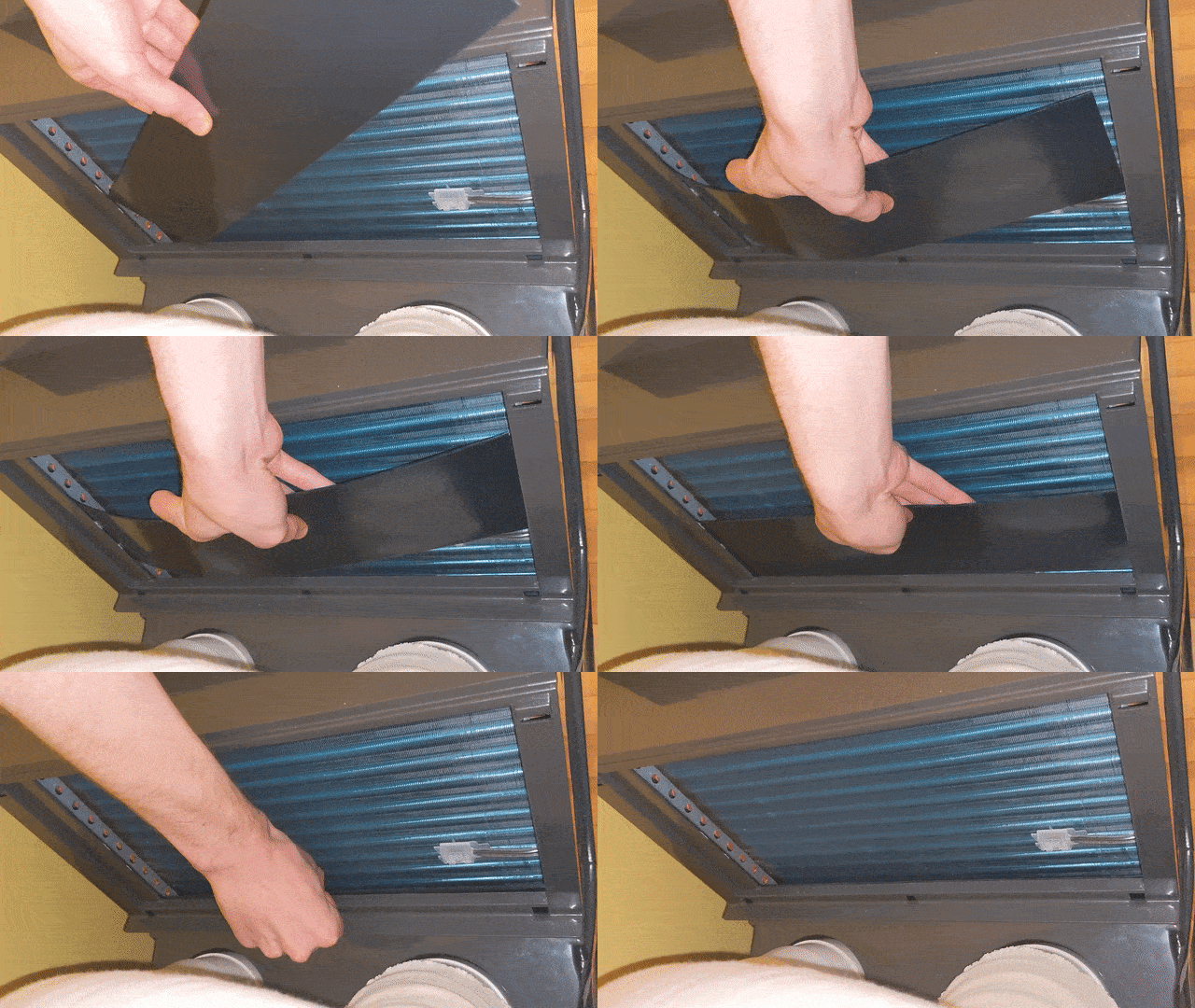
To block this one, I cut a 436mm x 98mm rectangle from a sheet of 1/16" (1.5mm) ABS plastic. A cereal box also works for prototyping purposes... in general, the material needs to be pretty thin, but rigid enough to keep itself flat.
FlukeESA615
According to this article, "infiltration air" is a major factor in the SACC measurement: https://support.edgestar.com/hc/en-us/articles/115005480926-What-is-SACC-Seasonally-Adjusted-Cooling-Capacity-
To make the unit run quieter, I started by wrapping it with a blanket, held in place using tape. The hoses prevent anything from obstructing the room air intake. Here is my "A/C burrito" prototype:
All in all, MLV does reduce noise from the compressor, but there's still plenty of blower noise. I'm not sure to what extent the cotton wrap helps to reduce reflected sound, but at least it looks nicer than raw vinyl.
The area that you've taped up is considered an overflow release. You are perfectly welcome to keep that area taped up though as it shouldn't cause an issue. My engineers have informed me that it's OK to do this.
One caveat to this installation is that my windows are locked/taped into position, so I can't open them at night when the air is cooler outside. It would be nice to have an automatic "ventilate" mode for this purpose. However, an A/C cooled with cool air produces even colder air, so it doesn't need to spend much time running in this state.
Fluke esa609for sale
I wasn't able to get an answer for this from my engineers about the effect on sealing the gap will have on efficiency. They did say that when the units are tested, they are tested with this gap to produce that SACC rating. There's no modifications to the units done while testing. The efficiency of the units includes the air gap.
24VAC relay module, with 10K resistors and optocouplers (Note: for compatibility, it may be useful to parallel each connector with a 1K 1W resistor):
There are velcro strips along the top (with opposing velcro hot-glued to the A/C), and on the back so the burrito can attach to itself.
You can rip open a standard furnace air filter, and cut the zig-zag part to fit the air intake's plastic frame. Note that this will restrict airflow, so it probably makes sense to run the blower on high. I increased the density a bit after taking this photo:
Our versatile, ISO/IEC 17025:2005 and ANSI/NCSL Z540-1-1994 accredited calibration laboratory offers on-site, in-house calibration, and repair services
In order to test these modifications, I installed the air conditioner in a somewhat-sealed closet with a 1.5m² volume. I initialized the temperature to roughly 72°F, set the A/C to 61°F (the minimum value), and let it run for about 3 minutes until the blower shut off.
Calibration of the FLUKE ESA609 is an important process that helps to ensure the accuracy and reliability of the device. It helps to ensure that the analyzer is providing accurate readings and that the device is functioning properly. By regularly calibrating the FLUKE ESA609, technicians can help to ensure the safety of electrical equipment and reduce the risk of hazardous situations.
These modifications are intended to make the condenser compartment run hotter, which may shorten the life of some components, but I have no idea which ones or by how much. I at least have a couple bits of evidence that this might not be a terrible idea:



 Neil
Neil 
 Neil
Neil